About Us



The
Chosen One
The One Who Set the Standards in Leadership
The Founder of the Institute
Dr. Syed Jamal Haider has been a scholar-practitioner for more than twenty-seven years. He brings a high degree of practical relevancy to his consulting and teaching practice as a result of his diverse working experience in the industry and higher education settings. During his fourteen years working at the largest multinationals in United States – Cargill, Incorporated and HSBC Finance Corporation – Dr. Haider worked on myriad projects in leadership and organizational development, including performance management, career development, team building, process improvement, and management and leadership development in five different competencies: personal, interpersonal, business, project management and technical.
As a Professor of Leadership, he also taught at George Mason University, South Korea, and Lahore University of Management Sciences (LUMS), Pakistan. Moreover, for five years he served as the Director and Professor of Leadership and Management Program at the University of Saint Mary, USA. He is author of the book, Transformation Leadership, a two-year research study of market conditions and organizational factors, including leadership style, culture, mission and strategy to analyze the economic performance and profitability of a subsidiary of a multinational firm. Research signified that leadership is the driving factor behind a high-performance culture to achieve organizational goals. His research experience also includes conducting focus groups in United States, Europe, Latin America and Asia to assess skill standards to improve training and developmental planning practices of multinationals. Moreover, he has received numerous awards for establishing on-going learning processes to keep students and employees’ knowledge and skills current and competitive with the marketplace.
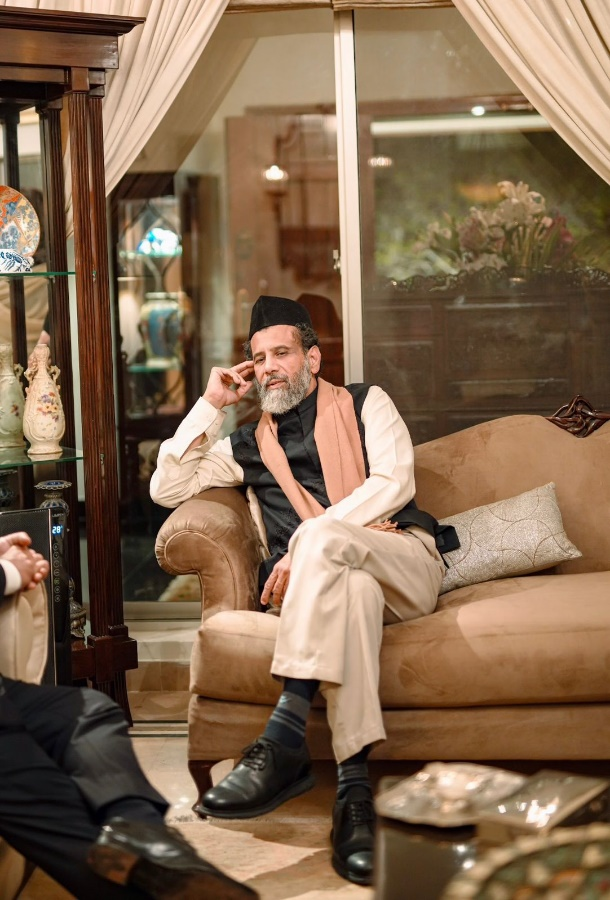
Dr. Syed Jamal Haider
- Doctorate in Leadership and Management (Ed.D., 2010), University of St. Thomas (UST)
- Master of Business Administration (MBA, 2007), UST
- Master of Educational Leadership (M.Ed., 2002), UST
- Master of Business Communication (MBC, 2000), UST
- Bachelor of Science, Information Systems (B.Sc., 1989), MN State University, Moorhead.
- High School Diploma (1982), Lahore American High School
The Need for
For nearly three decades, I have lived at the intersection of industry and academia—as a practitioner-scholar in leadership development. Across boardrooms and classrooms, one question has persistently followed me: what truly makes a leader? The world offers no shortage of leadership theories or models. Yet beneath them all lies a simple, often overlooked truth: leadership is not an accident. It is cultivated—through deliberate, focused training that shapes not only the mind, but the character. And yet, much of what truly forms a leader is not taught, even at the world’s most prestigious institutions. Universities equip individuals with knowledge. But leadership demands something greater—judgment, self-mastery, courage, and the ability to move others toward a shared vision.
Organizations like General Electric invest over a billion dollars each year to develop leaders within their ranks. They understand that leadership cannot be left to chance.
I have seen this transformation up close. During my time leading leadership initiatives at Cargill, Incorporated and HSBC Finance Corporation, I witnessed individuals evolve—quiet potential turning into decisive leadership, uncertainty into clarity, and effort into impact.
- Leaders are people with values. Honesty and integrity are the hallmarks of their character.
- They have a clear vision of the future, and the ability to communicate it in a persuasive manner.
- Leaders can influence behavior and thinking and are skilled at gaining commitment and inspiring individuals to surpass self-imposed limitations.
- They are calm under pressure, confident, and predictable during crisis. Leaders continually ask questions, probing for information, and testing their own perceptions.
- They look for ways in which things can be improved and encourage innovation and risk taking in identification and implementation of change.
- They bring out the best in people through trust, respect, listening, inspiration, sacrifice, and by setting an example.
Therefore, Institute for Strategic Leadership and Management has been established with the mission to fill the leadership void. We aim to develop world-class leaders of tomorrow who would act as change agents and transform their communities, organizations and nations.
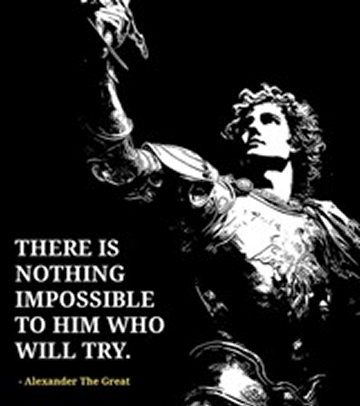
This Also Answers the Question:
What Made Alexander,
Alexander the Great?
It was not power alone. It was mentorship. Under the guidance of Aristotle, Alexander the Great reshaped his thinking—his assumptions, his worldview, his understanding of life itself. And in doing so, he reshaped history. A single flawed assumption can bring down an empire. But a single corrected belief can build one. Every champion, in every field, has had a coach.
We often hear that practice makes perfect. It is a comforting idea—but it is incomplete. Practice does not make perfect. It makes permanent. Only the right practice creates excellence. And the cost of getting it wrong is measured in missed opportunities, unrealized potential, and legacies that never fully form.
- How many brilliant minds have remained unseen—not for lack of knowledge, but for lack of direction?
- How many scholars stumble through a lifetime of poverty because they master the Britannica A to Z, but never learn the laws of action or success.
- How many transformative ideas have faded away because their creators never learned to lead people?
- How many gifted professionals have fallen short because they mastered their craft, but not themselves?
- How many opportunities were lost—not to failure, but to hesitation and fear?
- How many lives have been lived below their potential, constrained not by circumstance, but by self-imposed limitations?
What determines the leadership journey is not talent alone. It is the willingness to build—deliberately and relentlessly—a foundation of character, discipline, and vision. Leadership, then, is not a destination reserved for the few. It is a path—demanding, intentional, and transformative—for those willing to walk it.